


VKLM FIRE
The portal for public information to residents within the Victor Khanye Municipal area on safety





Legal stuff:
- This Website and all of its sub-pages are an independent run website with the pure intention of providing the community residing within the Victor Khanye Local Municipality information related to fire, life safety, Disaster Management and weather outlooks as well as notifications for adverse conditions that may impact all during a disaster or threatening disaster. In NO CIRCUMSTANCES is this page to be considered as an official page of the Victor Khanye Local Municipailty or representing this organization. To stop any allegations it is hereby registered that this site will remain independant and are 100% funded by the owner thereof.
- The Victor Khanye Local Municipal website can be visited at www.vklm.gov.za
- All weather related data is received or extracted with gratitude from the South African Weather Services (www.weathersa.co.za) with the exception of the UV Index map, which is obtained from SAWX (www.sawx.co.za), temperature graphs are obtained from Accuweather (www.accuweather.com). It may occur that the SAWS site is unavailable at the time of refreshing this page, on which instance the data from Windy (www.windy.com) are used for graphical representation and with comparison to the meteoblue or ECMWF data available from this site.
- Warnings are issued by the South African Weather Services (SAWS) ONLY in the form of emails or message systems and those relevant to the Victor Khanye Municipal area is published under the "Weather Warnings" box on the main page for information and early warning purposes to the community.
By notice from the Webmaster
Fire Prohibitions effective as from Today, 1 June 2021
South Africa have moved back to Adjusted Level 3 as a result from the rapid rise in infections.
Please adhere to COVID-19 regulations and STAY SAFE
Firebreak Guidelines
1. Legislative requirements
Firebreaks must be viewed as an integral part of the fire management strategy and not as a separate protection measure.
Every owner on whose land a Veldfire may start or burn or from whose land it may spread must prepare and maintain a firebreak on his or her side of the boundary between his or her land and any adjoining land except where exempted.
Owners of adjoining land may agree to position a common firebreak away from the boundary.
An owner who is obliged to prepare and maintain a firebreak must ensure that, with due regard to weather, climate, terrain and vegetation of the area-
- It is wide and long enough to have a reasonable chance of preventing a Veldfire from spreading to or from neighboring land;
- It does not cause soil erosion; and
- It is reasonable free of flammable material capable of carrying a Veldfire across it.
All burning operations must be conducted after obtaining a Burn permit, especially during winter period and after a Fire Prohibition notice is published to ensure all safety requirements are in place to attempt to prevent a fire operation becoming uncontrolled.
2. Purpose of Firebreaks
The purpose of a firebreak will determine what type of construction the firebreak should conform to. The purpose of firebreaks could be to:
- Prevent fire spread of controlled or uncontrolled fires
- Point where fire may be extinguished
- Point where back burns may be started
- Point of attack of fire
- Access point to a fire
It is difficult to document prescriptions for firebreaks. Each firebreak with its individual circumstances will determine what type and width will be applicable.
3. Factors influencing Fire break construction
The following factors must be taken into account with the construction of firebreaks.
Topography
- Slope of the ground
- Landscaping
- Elevation
Vegetation type
- Moisture content
- Size and shape of material
- Volume and area covered
- Fuel content.
Weather patterns
- Wind direction
- Temperature
- Rainfall
Conservancy aspects
- Erosions possibilities
- Scarce/endangered species
Spotting distance
Method of clearing
Cost of maintenance
Purpose of firebreak
Alternate position of firebreak
Width of firebreak
4. Procedure to apply for fire permits
- Complete an application to perform a burn operation indicating the address/area where you intend to perform the burn operation. Indicate type of burn operation.
- Discuss the intention with all adjoining neighbours, they must sign the application form as proof of the discussion and that they do not have any objections to the intended operation. Also to adhere to the requirements for them to have knowledge and be prepared for trouble at that period, if for some reason the operation becomes out of control. (Which should not occur if all requirements are met).
- This signed application must be forwarded to the Fire Protection officer for processing at the supplied email address.
- If the Fire Protection Officer is satisfied that all safety precautions have been met, a burn permit will be issued to the applicant.
- Burn permits are issued as per application dates, but will not be for a period longer than four days after approval. If additional days are needed or the operation could not be started or concluded in the four day period, the applicant must inform the Fire Protection Officer of this and obtain a new permit with amended dates.
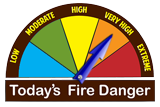
- Note: no burn permit will be issued for days with a High Orange or higher fire danger index. Each application will be managed as per received applications.
- The Fire Protection Officer reserves the right to suspend any issued burn permits if the Fire Danger Index worsens or weather conditions deteriorate. The permit owner will be informed of any such suspensions.
5. Firebreak requirements
Members are to maintain firebreaks on all property boundaries except where exempted.
5.1 Initial preparation and clearing of firebreaks
- No permanent internal breaks
- Only brush cut and raked breaks, no burnt breaks
- All the material may be burnt, chipped or removed
- It is preferred where possible not to redistribute material adjacent to cleared breaks
- Use natural boundaries and roads and cultivated lands
- Avoid wetlands and rare/endangered plant communities.
- By agreement of adjoining landowners breaks may be moved from the common boundary to a more practical and effective position.
5.2 Position
The position of the firebreaks will be determined by the factors as mentioned above.
5.3 Width
The minimum width will depend on the fuel load, slope and urban hazard but should not be less than 10m. (On a common boundary it is practice to have then 5m on each side of the boundary fence).
5.4 Annual maintenance
Belts to be brush cut or raked annually. This can be reviewed according to the regrowth.
Cut or raked material can be chipped, removed or burnt on site with the approved burning permit. It should preferably not be spread above the belt.
5.5 Types of Firebreaks
Fire breaks do not have to be cleared by means of burning. Other methods include the removing of vegetation or ploughing or scraping is also forms of firebreaks.
5.6 Temporary breaks
Temporary firebreaks may be prepared to isolate a fire hazard or for the purpose of prescribed burning after the required fire permits have been obtained.