


VKLM FIRE
The portal for public information to residents within the Victor Khanye Municipal area on safety





Legal stuff:
- This Website and all of its sub-pages are an independent run website with the pure intention of providing the community residing within the Victor Khanye Local Municipality information related to fire, life safety, Disaster Management and weather outlooks as well as notifications for adverse conditions that may impact all during a disaster or threatening disaster. In NO CIRCUMSTANCES is this page to be considered as an official page of the Victor Khanye Local Municipailty or representing this organization. To stop any allegations it is hereby registered that this site will remain independant and are 100% funded by the owner thereof.
- The Victor Khanye Local Municipal website can be visited at www.vklm.gov.za
- All weather related data is received or extracted with gratitude from the South African Weather Services (www.weathersa.co.za) with the exception of the UV Index map, which is obtained from SAWX (www.sawx.co.za), temperature graphs are obtained from Accuweather (www.accuweather.com). It may occur that the SAWS site is unavailable at the time of refreshing this page, on which instance the data from Windy (www.windy.com) are used for graphical representation and with comparison to the meteoblue or ECMWF data available from this site.
- Warnings are issued by the South African Weather Services (SAWS) ONLY in the form of emails or message systems and those relevant to the Victor Khanye Municipal area is published under the "Weather Warnings" box on the main page for information and early warning purposes to the community.
By notice from the Webmaster
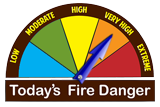
Fire Prohibitions effective as from Today, 1 June 2021
South Africa have moved back to Adjusted Level 3 as a result from the rapid rise in infections.
Please adhere to COVID-19 regulations and STAY SAFE
It is over 10 years since the Disaster Management Plan for the Victor Khanye Local Municipality was first developed and approved.
Since then there were developments that took place, changes in the weather patterns had significant impacts on the communities which therefore necessitate a re-look at the plan, update information as required and add new information/risks as may be necessary.
A process will be started whereby stakeholders will be engaged in consultation in order to be able to holistically incorporate relevant risks, opportunities and address shortcommings. Sifting through and research matters raised and incorporate this into the plan.
In addition, the Response and Relief plans also need to be redesigned and streamlined to bring them more in line with local available resources instead of what can be received from District and/or Provincial Disaster Centers (which will remain our support functionalries.
Therefore, as from July 2023 this process will commence in all earnest.
Below is a link to the current Disaster Management Plan for VKLM. and an Excel spreadsheet that can be populated and mailed back for incorporation into the master sheets. Any other inputs can be recorded and forwarded to the Chief Fire Officer who is responsible for Disaster Management in Victor Khanye Municipality. it is best to use the email (disastermng@942.co.za) for this purpose as his official email is receiving high volumes of mail and your inputs may become lost in between the mails.
We hereby invite all to please participate in this process in order to ensure the disaster management plan identifies all risks and addresses all possible mitigating options to reduce or eliminate the risks for our municipality.
We want to re-iterate that "Disaster Management is everybody's business"


Disaster risk is a part of the global Disaster Risk Reduction programme. Its main intention is to made the community aware of disaster hazards within the area they live and work. With the participation of willing communities, a better understanding of these hazards can be brought home and communities can take ownership of preventing man-made disasters before it occur. This assist with preventing destitution and unnecessary loss of life of loved ones or breadwinners.
We do not ask much from participants, the spreadsheet is very user-friendly and the link where to send the sheet to is available on the spreadsheet.
If you do not have a spreadsheet programme on our phone or tablet, then a link to an online form will be supplied shortly where exactly the same information can be recorded and submitted.
Some critical definitions to understand:
“disaster”
means a progressive or sudden, widespread or localised, natural or human-caused occurrence which—
(a) causes or threatens to cause—
(i) death, injury or disease;
(ii) damage to property, infrastructure or the environment; or
(iii) disruption of the life of a community; and
(b) is of a magnitude that exceeds the ability of those affected by
the disaster to cope with its effects using only their own
resources;
“disaster management”
means a continuous and integrated multi-sectoral, multi- disciplinary process of planning and implementation of measures aimed at—
(a) preventing or reducing the risk of disasters;
(b) mitigating the severity or consequences of disasters;
(c) emergency preparedness;
(d) a rapid and effective response to disasters; and
(e) post-disaster recovery and rehabilitation;
“Hazard”
A potentially damaging physical event, phenomenon or human activity that may cause the loss of life or injury, property damage, social and economic disruption or environmental degradation.
Hazards can include latent conditions that may represent future threats and can have different origins: natural (geological, hydro meteorological and biological) or induced by human processes (environmental degradation and technological hazards).
Hazards can be single, sequential or combined in their origin and effects. Each hazard is characterised by its location, intensity, frequency and probability.
“Vulnerability”
means the degree to which an individual, a household, a community or an area may be adversely affected by a disaster.
“Risk”
The probability of harmful consequences, or expected losses (deaths, injuries, property, livelihoods, economic activity disrupted or environment damaged) resulting from interactions between natural or human-induced hazards and vulnerable conditions.
Conventionally risk is expressed by the notation Risk = Hazards x Vulnerability. Some disciplines also include the concept of exposure to refer particularly to the physical aspects of vulnerability.
Beyond expressing a possibility of physical harm, it is crucial to recognize that risks are inherent or can be created or exist within social systems.
It is important to consider the social contexts in which risks occur and that people therefore do not necessarily share the same perceptions of risk and their underlying causes.
A WORLD MORE VULNERABLE TO DISASTERS
Open any form of news media, and you will find reports of flooding, earthquakes, volcanic eruptions, drought, famine, outbreaks, fire or other form of devastating event that affects a community or country.
With current analysis of disasters occurring worldwide, there is an indication that the trend is showing an increase in occurences and a higher increase in losses. This trend can be explained by people and communities becoming more vulnerable. We can even determine that the frequency of disasterous events may be constant, but it is human activities that contribute to their increased intensity. Examples of such activities are migration to cities or urban clusters, pollution, land erosion, and so much more that can be thought of. On this, and most probably the biggest threat is that many human activities have an impact on climate change, which have a knock-on results such as increase in sea levels, more fierce weather events to name but two.
More will be added soon...…
Please come back regularly