VKLM FIRE
The portal for public information to residents within the Victor Khanye Municipal area on safety





Legal stuff:
- This Website and all of its sub-pages are an independent run website with the pure intention of providing the community residing within the Victor Khanye Local Municipality information related to fire, life safety, Disaster Management and weather outlooks as well as notifications for adverse conditions that may impact all during a disaster or threatening disaster. In NO CIRCUMSTANCES is this page to be considered as an official page of the Victor Khanye Local Municipailty or representing this organization. To stop any allegations it is hereby registered that this site will remain independant and are 100% funded by the owner thereof.
- The Victor Khanye Local Municipal website can be visited at www.vklm.gov.za
- All weather related data is received or extracted with gratitude from the South African Weather Services (www.weathersa.co.za) with the exception of the UV Index map, which is obtained from SAWX (www.sawx.co.za), temperature graphs are obtained from Accuweather (www.accuweather.com). It may occur that the SAWS site is unavailable at the time of refreshing this page, on which instance the data from Windy (www.windy.com) are used for graphical representation and with comparison to the meteoblue or ECMWF data available from this site.
- Warnings are issued by the South African Weather Services (SAWS) ONLY in the form of emails or message systems and those relevant to the Victor Khanye Municipal area is published under the "Weather Warnings" box on the main page for information and early warning purposes to the community.
By notice from the Webmaster
Fire Prohibitions effective as from Today, 1 June 2021
South Africa have moved back to Adjusted Level 3 as a result from the rapid rise in infections.
Please adhere to COVID-19 regulations and STAY SAFE
Recent Significant Court Rulings related to Veld Fires:

In brief;
A claim was registered at the Appeals Court after the High court rejected a claim of
R 23 million from a plantation owner against his neighbour after a fire spread into his plantation and resulted in the loss of the plantation to the claimed value.
The Appeals court considered five elements in this case namely;
- 1 The actions of the neighbour. In that the neighbour was supposed to have anticipated the possible damages and made provisions timeously to react accordingly.
- 2 The second element investigated was that of wrongfulness. Here the reasonable farmer rule was applied. Did the neighbour act as what a reasonable farmer would have in the same circumstances.
- 3 The third element investigated was that of guilt, wilful or negligence with regards to the damages the claimant suffered.
- 4 The fourth element investigated was the element of negligence. If the neighbour did remove the flammable alien invasive plants, it could have prevented future spread of the species.
- 5 The last element investigated was of causality. This refer to the relationship between the actions of the neighbour and the resulting damages sustained, was there a casual line that could be drawn.
The Appeals court also ruled to the claim being rejected as the court found that the neighbour did everything in his power to try and stop the fire, but the fire did spread even with all the efforts implemented.
This case highlights the importance of having the necessary preventative measures in place against fires and to react quickly to fires on your property. If the farmer (Neighbour) did not put in place preventative measures and did not react quickly, this claim would have been awarded, which could have cost him his farm. It is also very important to have your employees trained in this regard, as most of these fires are caused by an innocent fire started to cook some food or to stay warm.
MTO Forestry v Swart (420/2016) [2017] ZASCA 57
Click here for the more detailed document of the above case, and
Click here for the original afrikaans article from Solidariteit website
INFORMATION PAGE
SAWS - Media Release
The updated Seasonal Climate Watch for Autumn have been published and can be downloaded here
RAINFALL SINCE THE START OF THE 2025/2026 RAINFALL SEASON
Note: Readings displayed are on the date of reading and represent the rainfall for the previous 24-hour period. Readings are taken at 07:00 each morning.
The current readings is not a true reflection of the area's rainfall as it is known that areas such as Argent and Eloff receives different rainfall amounts, but we do not receive readings from that areas.
Site: Delmas West (near Traffic Offices)
(S26˚09’03.02” and E28˚40’22.29”)
If there are community members on other areas within the Municipality that would like to participate with record keeping, kindly forward your readings to the Chief Fire Officer on email: firechief@vklmfire.co.za or per SMS or Whatsapp (0833773532)
For a more detailed breakdown of the rainfall on a daily basis, select this link Rainfall Register.
This register indicate rainfall for the current rainfall season cycle started from 01 September 2020.
Global Warming Situational awareness
For those who are still in denial.... Global warming is real and it is here and the effects are already being observed in an escalating frequency.
This extract is based on what will affect us here, locally.
In short for the remainder of this season (up to end October) we can expect a below normal rainfall period (Almost no rainfall up to October), with above normal average temperatures due to the El Niño state declining into a neutral state by end of winter. From October to December the SAWS is conservant as yet and cannot fully create a tangeable model due to the uncertainty of the ENSO (El Niño Southern Oscilating) effect. This makes forecast modeling very difficult and unpredictable. What can be said with confidence is that we can expect some rain through October starting from around the 10 to 11 October '24. The SAWS remains conservant that the El Niño effect will remain neatral for most of spring.
For the previous rainfall season for the rainfall recording site as noted to the right, a total of 622mm (see breakdown under the Rainfall Register (link adjacent). This means that on average Delmas received some good rains, but the spread thereof was not conducive for absorbtion. (The thunderstorm phenomenon) Underground water resources are compromised and the water table (height of the water underground). It was observed that the yield from boreholes have deceased and some dried up. There are three reasons therefore; 1) The current rainfall trend is not conducive for the replenishment of the underground water supplies, 2) The increased temperatures and weather conditions contribute to higher evaporation and extraction of water, and 3) the increase of people drilling boreholes for agricultural use (pivot points as example). {the challenge here is this is performed without the required approvals or licensing and is illegal and the rest of the rural population suffers as a result hereof}
The other challenge is above ground as well, dam levels are not where it should be in comparison (an approximate 8% less than the previous year on average) and that puts pressure on the demand and availability of water resources. The municipality is receiving Rand Water from the Vaal scheme, which, by comparison to the Mpumalanga dam levels are also showing risks of depletion. Gauteng already talks about day zero (as what happened in the Cape the previous season). If Rand Water or the Vaal scheme decide to implement water restrictions, it will most definately have an impact on our water availability levels, including the Standerton region. This is not scare tactics, it is the facts out of the data and it is going to affect us at some point if conditions does not improve.
Everybody is urged to consider water savings and to start investigating options to conserve water or lower water usage in order to lessen the strain on available resources.
A Climate crisis report was released on 5 November 2019 in the US on the critical situation on Climate change, over 11 000 scientists from 153 countries signed the report which states that the planet “clearly and unequivocally faces a climate emergency,” The article can be viewed (and I strongly urge all to go and read it) from the following website link: https://www.washingtonpost.com/science/2019/11/05/more-than-scientists-around-world-declare-climate-emergency/
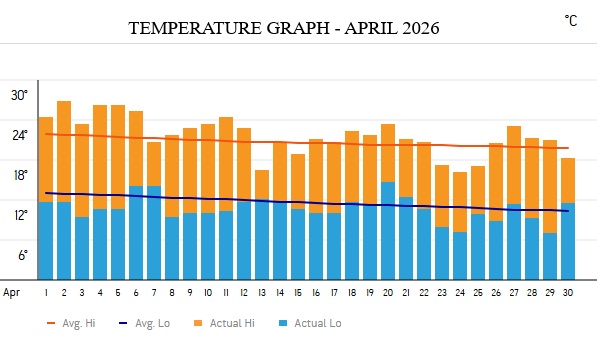
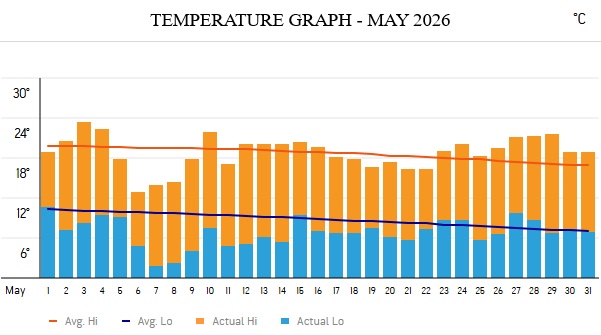
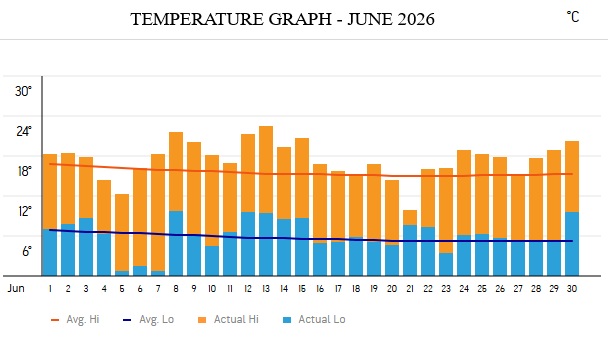
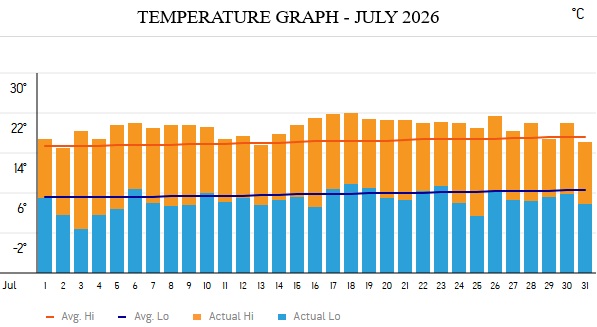
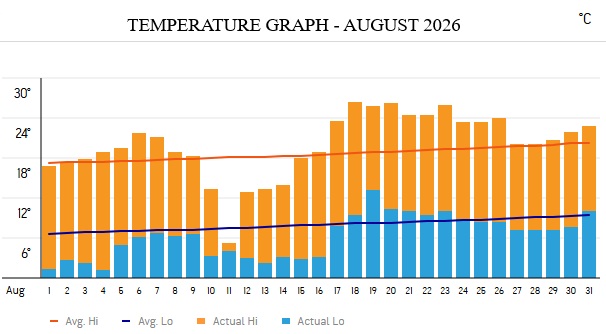
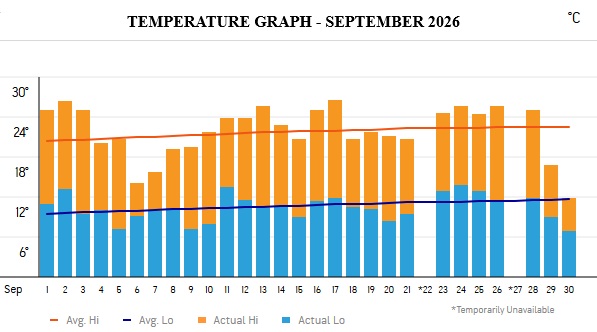
Historical data graph of previous five month's temperatures.
(extracted from www.accuweather.com)
South African Weather Service, model forecast for the summer period is summarised as follows;
The El Niño-Southern Oscillation (ENSO) which is currently in a Strong El Niño state and current predictions indicate that it will continue strengthening towards a very strong El Niño state within the next couple of months and last at least until the end of the 2026/27 summer season
What does this mean?
In summary, the typical signs that El Niño will affect South Africa are starting to materialise over the Pacific Ocean and it is expected that South Africa will experience the typical impacts of dryer and warmer conditions during this coming summer.
Predictions indicate that during late spring, early- and mid-summer there is increased chances for below-normal rainfall to occur over most of the north-eastern half of South Africa. This forecast is consistent with typical El Niño effects for Southern Africa. Minimum and maximum temperatures are largely expected to be above-normal for most parts of South Africa during the spring and early summer seasons.
Some scary facts from recent releases:
Kriel: Have been noted as the second highest
contributor to air pollution in the world. (2020)
eMahlaleni: Have been noted as possibly being the
second largest drug hub in South Africa
in terms of variety and supply of drugs.
(2020)
Victor Khanye: Delmas is amongst the areas with the
highest Hi-jacking trend in South
Africa (2020), which is a very scary
statistic. Almost all categories of
crime have shown an increase
according to Police statistics for 2021
and up to March 2022.
Stats on hijackings between
Dec 2021 and March 2022;
Delmas - 92% increase in Hijackings (Cars)
- 125% increase in Hijackings (Trucks)
Sundra - Similar rate in Hijackings (Cars)
- 300% increase in Hijackings (Trucks)
Still don't believe Global Warning is real
Australia:
December 2019: Worst wildfire recorded in their history. Fire rages since mid December 2019 and only now (9 January 2020) are being brought under control in some places. Wide areas have been destroyed by the raging and seemingly unstoppable fire. Hundreds of homes destroyed, wildlife deaths are confirmed at three people of which two were fire fighters. Nearly a thousand Koala's have been killed.
Indonesia:
While the wildfires raged in Australia, Indonesia suffered severe flooding, with floodwaters raising up to 6 meters, the death toll is still being tallied, but are already above 70 people confirmed.
Venice:
12 January 2020. Extreme low tides have left Venice's water channels with only the muddy basin of its watery streets. The water level have dropped with almost one meter in places.
And this is the most recent events known.
Increased numbers of Tropical Storms in 2020 for Northern Hemisphere
The 2020 Atlantic hurricane season was an ongoing tropical cyclone season, which featured tropical cyclones formations at an unprecedented rate.
Up to end September 2020, there were a total of 25 sub-tropical cyclones, 24 named storms, 8 hurricanes and 2 Major Hurricanes that left a wake of devastation in their wake.
Interesting fact: The Southern Hemisphere also had tropical storms in their season (2019-2020), of which Tropical cyclone Herold (April 2020) caused the highest damage through Vanuatu as a category 5
In April two Tropical cyclones was identified forming in the same period, the other was Tropical Cyclone Irondro East of Madagascar island that was tracked moving South-east and only grew to a category 1.
Slowing of the Gulf Stream off the East coast of America.
From a study published earlier this week the science community noted that the Gulf stream, also known as the Atlantic Meridional Overturning Circulation (AMOC) have slowed down considerably since the start of the 20th century. This can be mostly pinned to one catalyst, that of human-caused climate change.
The slowing down of this current can cause devastating phenomena, some thereof is rising ocean levels and temperatures, which will result in more destructive weather patterns and a decrease in rainfall. More on this will be put on the page as a link which can be read from AccWeather's site.
February 2021 was noted as a record month in terms of average temperatures over the globe
According to a recent report released from the National Oceanic and Atmospheric Administration (NOAA), February 2021 was the coldest February for the united States in over 30 years, and it was further the coldest February for the entire globe since 2014. The report went further to note that the central and eastern tropical Pacific ocean, Australia and parts of the southern oceans were also notably colder during February 2021 in comparrison to recent years.
In addition, not all places experienced below-normal average temperatures, Eastern Canade, central and southeastern Europe and Asia were notably warmer that average for February 2021. (**Source: NOAA Report)
July 2023 was noted as another record month on the heels of the July 2021 records in terms of average temperatures over the globe
Globally, July 2023 was the world's hottest month ever recorded. Data shows that the combined land and ocean surface temperature was 1,18 degrees Celsius (0,93 degrees Celsius in July 2021) above the 20th Century average of 15,8 Degrees Celsius. This is the highest temperature in the 143 years of record keeping. (**Source: NOAA Report and GISS Analysis)
Monday 4 October 2021 - Continental rainfall records - Italy.
Italy has seen its all time high rainfall record of recorded history on Monday. over a 24-hour period a record 883,8mm of rain fell. In the city, Rossiglione, in a 12-hour period from 05:40 to 17:40 their time, the city recorded a staggering 740,6mm, which was just over 82% of their annual rainfall and which broke the record for the continent.
(**Sources: Accuweather; SkyNews; The Guardian)
Saturday 13 August 2022 - Waterspout - Velddrift (Western Cape)
On the 13th August 2022 between 16:00 and 16:20 a single Cumulus congestus cloud spawned a waterspout that hit Velddrif in the Western Cape and caused infrastructure damage to isolated houses and an apartment building along the Berg River.
Tropical Storms for the 2026/2027 Season
~ South Indian Ocean Basin ~
Storm/Cyclone System duration Peak windspeed
(Km/h)
Crime safety announcement:
.
As we near the silly season, your attention is drawn to opportunistic crimes such as house break-ins. As you prepare to go away during the festive season, also ensure that your home security is attended to. These petty criminals move about and observe homes with poor security where there are no movement for a few days, then they break in and take what they want and leave you with destruction.
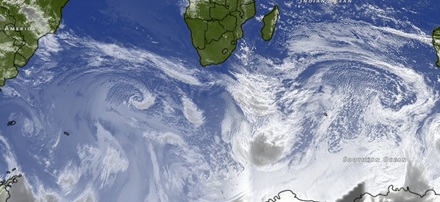
The satellite image is extracted as at 06:30 this morning
| DATE | Total Monthly Rainfall recorded (mm) |
| SEPTEMBER 2026 Total OCTOBER 2026 Total NOVEMBER 2026 Total DECEMBER 2026 Total JANUARY 2027 Total FEBRUARY 2027 Total MARCH 2027 Total APRIL 2027 Total MAY 2027 Total JUNE 2027 Total JULY 2027 Total AUGUST 2027 Total
Total Rainfall recorded for the 2026/2027 Rainfall season
|
76
{ 76 }
|
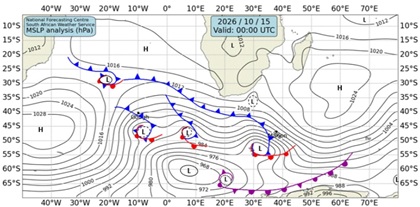
Weather Systems within the South Indian Ocean Basin
No tropical systems observed today.
PROVINCIAL AMBULANCE SERVICES
The service delivery challenges of the Mpumalanga Provincial Ambulance Services in terms of their Call Centre not answering or the serious delays caused by Ambulance crews not responding in time or "getting lost" because they do not know the area is unfortunately a matter outside the control of local government.
Kindly direct all complaints to the Provincial Department of Health Complaints line at 0800 204 098 or to the Presidential hotline at 17737 or email at president@presidency.gov.za
COVID-19 cases within Victor Khanye Local Municipal area as at 30 June 2021
Active cases = 139
INFORMATION UPDATED AS MADE AVAILABLE FROM THE MPUMALANGA HEALTH DEPARTMENT
PLEASE DO NOT CREATE A FALSE SECURITY BASED ON THE DEATH STATS
Tropical Storms in Indian Ocean Basin